
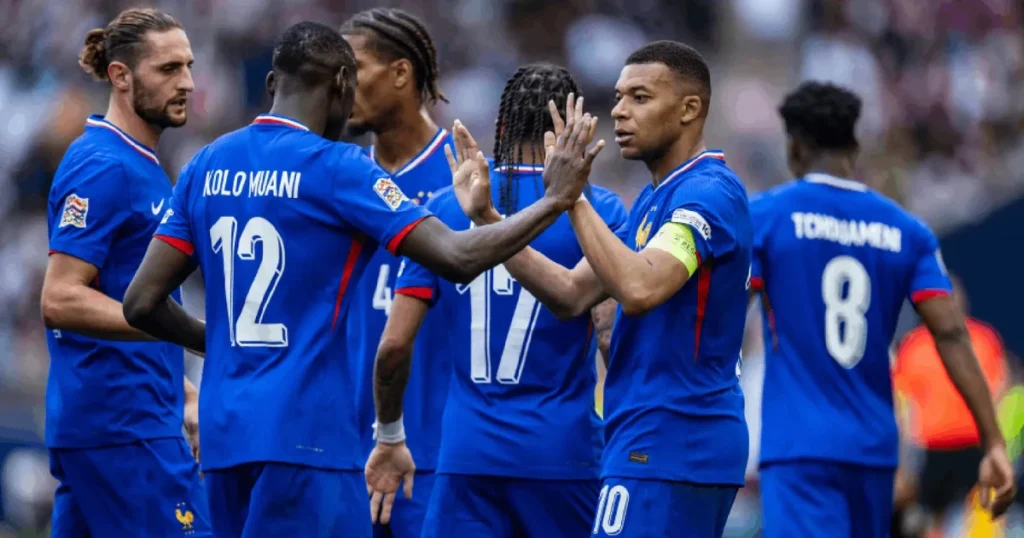
The France national football team, affectionately known as Les Bleus, has long been a symbol of flair, resilience, and unyielding ambition on the global stage. From the sun-drenched pitches of the 1930 World Cup to the electric atmosphere of modern showdowns, the France football team embodies the passion of a nation that views soccer not just as a game, but as a cultural heartbeat. Whether you’re tuning in for the latest France next match or dissecting their climb in the France FIFA ranking, there’s no denying the magnetic pull of this squad. As of November 2025, Les Bleus hold a commanding third place in the FIFA rankings, behind only Spain and Argentina—a testament to their blend of tactical nous and individual brilliance. In this deep dive, we’ll journey through their storied history, celebrate their triumphs, spotlight the stars who light up the pitch, unpack their strategic evolution, review recent heroics, preview what’s ahead, revel in the fervor of their supporters, and gaze toward a future ripe with potential. Buckle up; this is the tale of a team that’s as unpredictable as it is unstoppable.
A Storied Past: The Evolution of the France Football Team
The roots of the France football team stretch back to the dawn of organized international play. Founded in 1904 under the auspices of the French Football Federation (FFF), Les Bleus kicked off their competitive era with a 3-3 draw against Belgium on May 1 of that year—a fittingly spirited baptism that hinted at the drama to come. Early years were marked by inconsistency; France co-hosted the inaugural 1938 World Cup but exited in the round of 16, a far cry from the dominance they’d later unleash.
The post-World War II era brought glimmers of promise. The 1950s introduced legends like Just Fontaine, whose 13 goals at the 1958 World Cup remain a tournament record, propelling France to a third-place finish—their best at the time. Yet, it was the 1980s that ignited true fervor. Under manager Michel Hidalgo, a “Magic Square” midfield featuring Platini, Alain Giresse, Jean Tigana, and Luis Fernández orchestrated balletic dominance. This golden quartet led Les Bleus to their first major trophy: the 1984 UEFA European Championship on home soil. Platini’s nine goals in five matches—a record that stands unchallenged—sealed a 2-0 final win over Spain, sparking nationwide euphoria.
The 1990s and early 2000s defined a multicultural renaissance. Aimé Jacquet’s diverse squad, dubbed the “Black, Blanc, Beur” generation for its blend of ethnicities, hosted and won the 1998 World Cup. Zinedine Zidane’s two headers in the 3-0 final rout of Brazil united a fractured nation, with over a million fans flooding the Champs-Élysées in celebration. This triumph was followed by Euro 2000 glory, making France the second team ever to hold both the World Cup and Euros simultaneously. But hubris followed; a shocking 1-0 loss to Senegal in 2002 saw them crash out of the World Cup group stage as defending champions.
Rebirth came in the 2010s under Didier Deschamps, a 1998 World Cup-winning captain turned pragmatic maestro. Hosting Euro 2016 ended in heartbreak—a 1-0 extra-time final loss to Portugal—but it rebuilt momentum. The pinnacle arrived in 2018: a clinical World Cup conquest in Russia, capped by a 4-2 final victory over Croatia. Les Bleus’ defense, dubbed the “Mur de Fer” (Iron Wall), conceded just one goal en route. The 2021 UEFA Nations League triumph added another layer, cementing France as Europe’s most decorated side alongside Germany, with nine major honors.
Through it all, the France football team has mirrored societal shifts—from immigration debates in 1998 to unity in 2018. Their journey isn’t linear; it’s a saga of peaks, valleys, and relentless reinvention, always with that Gallic rooster emblem crowing defiance.
Triumphs That Echo Through Time: Major Achievements of Les Bleus
What sets the France football team apart isn’t just participation—it’s conquest. With two FIFA World Cups (1998, 2018), two UEFA European Championships (1984, 2000), two FIFA Confederations Cups (2001, 2003), one Olympic gold (1984), and the inaugural UEFA Nations League (2021), Les Bleus boast a trophy cabinet rivaling the elite. They’re one of only two nations (with Brazil) to win every senior FIFA men’s competition, a feat completed in 2013 with the U-20 World Cup.
The 1998 home triumph stands eternal: Zidane’s brace against Brazil not only ended 28 years of World Cup hurt but symbolized integration, with 17 of 23 players boasting immigrant roots. Euro 2000 followed seamlessly, a 2-1 golden-goal win over Italy showcasing Thierry Henry’s predatory instincts. The 1984 Euros, Platini’s masterclass, remains a blueprint for home-soil magic—five straight wins, including a semifinal penalty shootout over Portugal.
Recent glories shine brightest. The 2018 World Cup was a masterclass in efficiency: Paul Pogba’s midfield mastery and Kylian Mbappé’s teenage dynamism dismantled Argentina 4-3 in the round of 16. The Nations League final in 2021—a 2-1 extra-time edging of Spain—highlighted depth, with N’Golo Kanté’s tireless engine pivotal. Even silverware like the 2001 and 2003 Confederations Cups, both 1-0 finals (Japan, Cameroon), underscore consistency.
These achievements aren’t mere silver; they’re cultural milestones. The 1998 win boosted GDP by 0.5% through tourism and merchandise, while 2018’s parade drew 3 million Parisians. In a sport of heartbreak, Les Bleus’ haul—runners-up in 2006 and 2022 World Cups, Euro 2016—proves they’re perennial contenders, their France FIFA ranking a constant top-five fixture.
Stars on the Pitch: Key Players Who Define the France Football Team
The France football team thrives on icons—players who transcend the pitch, becoming national treasures. Past luminaries like Platini (41 goals in 72 caps) and Zidane (31 in 108) set the bar, but today’s squad pulses with youth and verve.
Kylian Mbappé, the 26-year-old Real Madrid phenom, is the undisputed talisman. With 48 goals in 84 caps as of November 2025, his blistering pace and clinical finishing lit up the 2018 World Cup (four goals) and nearly clinched 2022’s final (hat-trick vs. Argentina). Off the ball, his leadership—captaining in Deschamps’ absences—echoes Zidane’s poise.
Antoine Griezmann, Atletico Madrid’s evergreen forward, brings 44 goals in 138 appearances. His 2018 World Cup Player of the Tournament award (four goals, two assists) and Euro 2016 Golden Boot highlight versatility—scoring, creating, even dropping deep to orchestrate.
Midfield maestro Aurélien Tchouaméni (25, Real Madrid) anchors with poise, his 2025 form yielding three assists in qualifiers. Eduardo Camavinga (22, Real Madrid) adds dynamism, his box-to-box energy a Kanté successor. Defensively, William Saliba (24, Arsenal) forms an impregnable duo with Dayot Upamecano (27, Bayern), their aerial prowess key to the Iron Wall legacy.
Veterans like Olivier Giroud (retiring post-2026?) offer wisdom—57 goals, France’s all-time top scorer—while emerging threats like Bradley Barcola (PSG) and Désiré Doué (PSG) signal depth. This blend of experience and exuberance keeps Les Bleus elite, each player a thread in the tricolor tapestry.
Mastering the Game: Tactics That Power the France Football Team
Under Deschamps since 2012, the France football team has evolved into a tactical chameleon—pragmatic yet potent. His hallmark? Adaptability within a rigid framework, often a fluid 4-3-3 morphing to 3-4-3 for balance. Build-up emphasizes a back four with a lone pivot (Tchouaméni) shielding, allowing eights like Camavinga to surge forward. Wingers—Mbappé left, Dembélé right—stretch defenses, feeding Griezmann’s false-nine runs.
Defensively, it’s fortress-like: high, narrow pressing regains possession swiftly, transitioning to lethal counters. The 2018 World Cup exemplified this—conceding once, scoring 14 via rapid breaks. Critics dub it “anti-football” for its conservatism, but results silence doubters: only one tournament exit before semis under Deschamps.
In attack, fluidity reigns. Griezmann drops to link play, freeing Mbappé for one-on-ones. Against possession-heavy foes like Spain, France cedes the ball (45% average) but strikes surgically—think 2022’s 2-1 quarterfinal dissection of England. Deschamps’ water-carrier ethos—prioritizing collective over flair—has yielded a 70% win rate, blending Hidalgo’s artistry with modern steel.
Recent Form: Momentum Building in 2025
2025 has been a qualifier masterclass for the France football team, blending dominance with resilience. Kicking off with a Nations League campaign that saw them top their group (wins over Belgium 2-0, Italy 3-1), Les Bleus carried fire into World Cup qualifying. A 4-0 demolition of Ukraine on November 13—Mbappé’s brace, Griezmann assist—clinched their eighth straight World Cup berth, the second European side to qualify. Days later, a 3-1 friendly vs. the Faroe Islands added gloss, with Barcola’s debut goal signaling youth infusion.
Earlier hiccups—a 1-1 draw with Iceland in October—tested resolve, but a 2-0 Azerbaijan romp steadied nerves. Overall, eight wins in 10 matches, 22 goals scored, five conceded. Mbappé (seven goals), Griezmann (five assists) shone, while Saliba’s clean sheets underscored defensive steel. This surge vaults them to third in the France FIFA ranking, primed for December’s draw.
| Recent France National Football Team Results (2025) | ||||
|---|---|---|---|---|
| Date | Opponent | Result | Competition | Key Performer |
| Nov 16 | Azerbaijan | 2-0 W | WC Qualifier | Tchouaméni (Goal) |
| Nov 13 | Ukraine | 4-0 W | WC Qualifier | Mbappé (2 Goals) |
| Oct 12 | Iceland | 1-1 D | WC Qualifier | Griezmann (Assist) |
| Oct 9 | Azerbaijan | 2-0 W | WC Qualifier | Camavinga (Goal) |
| Sep 7 | Italy | 3-1 W | Nations League | Barcola (Goal) |
| Sep 4 | Belgium | 2-0 W | Nations League | Saliba (Clean Sheet) |
This table highlights Les Bleus’ consistency, with wins in seven of eight competitive games—a roadmap for glory.
On the Horizon: Upcoming Fixtures and the France Next Match Buzz
With World Cup qualification secured, focus shifts to friendlies and Nations League remnants, but the real heat builds for 2026. The December 5 draw in Washington D.C. looms, pitting France in Group D or L—potential clashes with the Netherlands or Ukraine. The France next match? A December 20 friendly against Morocco in Casablanca, a nod to heritage and a tune-up for summer.
2026 explodes with qualifiers wrapping in March (vs. Bosnia, say), then the Nations League finals in June. The World Cup proper—hosted across USA, Canada, Mexico—kicks June 11, with Les Bleus eyeing an early group in Los Angeles or Seattle, leveraging expat support. Euro 2028 (UK/Ireland) follows, but 2026 is the grail: a third star on the jersey.
Deschamps plans a 26-man squad, blending vets with prodigies. Expect electric clashes—Mbappé vs. Messi redux?—as France chases history.
The Heartbeat of the Nation: Fan Culture Surrounding Les Bleus
No team captivates like the France football team when fervor ignites. Nicknamed Les Bleus for their iconic azure kits, supporters transform Paris into a sea of tricolor during tournaments. The Stade de France, a 80,000-seat coliseum in Saint-Denis, pulses with “Aux armes, citoyens!” chants and tifo mosaics from groups like Irresistibles Français—blue flares, rooster banners, pure theater.
Fan culture transcends borders: Bastille Day parades swell post-victory, while diaspora communities in Africa and the Caribbean host watch parties. The 1998 win birthed “Zidane fever,” uniting immigrants and natives; 2018’s parade drew 3.5 million, dwarfing Bastille crowds. Yet, it’s not flawless—2002’s flop sparked “Les Sans” derision—but resilience defines it. Women-led ultras and global pods amplify voices, making support a multicultural mosaic. In cafes from Lyon to Lille, every France next match is communal ritual—beers raised, debates fierce, unity unbreakable.
Charting the Course: Future Outlook for Les Bleus
The horizon gleams for the France football team. Qualified for 2026, they’re favorites—Mbappé (26), Camavinga (22), Tchouaméni (25) peak at prime age, backed by Saliba’s steel and Olise’s creativity. Deschamps exits post-tournament, his 70% win rate a parting gift; successor? A Zidane return whispers.
Challenges loom: Integrating post-Giroud/Lloris eras, managing egos in a 26-man squad. Yet, depth dazzles—two world-class forward lines, midfield endless. Pundits forecast a third World Cup, Euro 2028 defense. With France FIFA ranking locked top-three, and expat boosts in North America, Les Bleus eye dynasty. By 2030, Mbappé could eclipse Henry’s 51 goals. The future? Not just bright—blinding.
In the end, the France national football team isn’t merely a squad; it’s a saga of swagger and substance, heartbreak and heroism. From Platini’s poetry to Mbappé’s lightning, Les Bleus remind us: football’s magic lies in the chase. As they gear for the next conquest, one thing’s certain—when the rooster crows, the world listens. Allez les Bleus!